
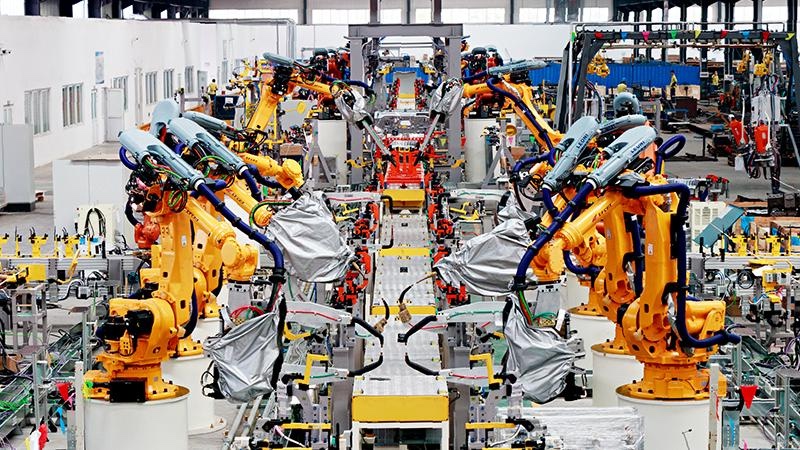
China now operates more industrial robots than the rest of the world combined, a statistic that, at first glance, paints a picture of complete industrial automation dominance.
Yet, this seismic fact, delivered by the International Federation of Robotics, merely scratches the surface of a far more intricate and compelling narrative unfolding within the nation’s borders.
Beyond the sheer volume lies a multi-billion dollar technological crucible, a fiercely contested arena where global industrial giants clash with ambitious local startups, all vying for supremacy in a market that is reshaping the future of manufacturing.
This isn’t just about numbers; it’s about a strategic gold rush that has been underway for over a decade.
In 2023 alone, China installed an astonishing 290,000 industrial robots.
With units ranging from $10,000 for simpler models to over $100,000 for highly specialized systems, a conservative average estimate of $50,000 per unit places the market for new robots in China at a staggering $14.5 billion annually.
This colossal sum is the prize in a battle for technological and market leadership, a high-stakes game that has fundamentally altered the global automation landscape.
For many years, the industrial robotics sector was the undisputed domain of a powerful quartet: Japan’s Fanuc and Yaskawa, Switzerland-Sweden’s ABB, and Germany’s Kuka.
As China’s manufacturing engine roared to life, these titans recognized an opportunity too vast to ignore.
Their strategy was not merely to export to China, but to truly become Chinese.
Over the past 10 to 15 years, they poured immense resources into establishing state-of-the-art production facilities, expansive R&D centers, and robust sales networks directly on Chinese soil.
This “in China, for China” approach was a masterstroke of localization, allowing them to sidestep import tariffs, slash production costs, and respond with unparalleled agility to the unique demands of the local market.
For a considerable period, their reputation for superior precision, unwavering 24/7 reliability, and sophisticated software kept them at the pinnacle, justifying premium price tags in critical sectors like automotive manufacturing, where failure simply isn’t an option.
The landscape, however, shifted irrevocably in 2017 with a single, landmark transaction: the €4.5 billion acquisition of Kuka by the Chinese home appliance giant, Midea.
This was no ordinary corporate takeover; it was a strategic declaration.
Overnight, China gained not only a globally recognized robotics brand but, crucially, its deep-seated intellectual property.
The Kuka acquisition sent shockwaves through the industry, immediately transferring Kuka’s substantial 10-15 percent slice of the Chinese market from the “foreign” column to the “Chinese” ledger.
This singular move propelled the reported share of Chinese-owned robotics companies into double digits and, more importantly, served as a clarion call.
It underscored Beijing’s strategic emphasis on robotics and ignited a surge of investment and ambition among domestic players.
Inspired and emboldened, Chinese companies began their relentless climb.
Siasun, often seen as a national champion with strong state backing, pivoted to developing comprehensive, heavy-duty automation solutions.
Meanwhile, Estun Automation adopted a more agile, market-driven approach, cultivating a broad portfolio of cost-effective robots specifically designed for the vast small and medium-sized enterprise market.
Bolstered by powerful government initiatives like “Made in China 2025,” which provided substantial subsidies and purchasing incentives, these local manufacturers were given the impetus and resources to innovate and compete.
Today, the Chinese robotic arm market is a stratified and intensely competitive arena, where the balance of power is in constant flux.
While the foreign giants still command a significant majority of the market’s value, especially in the most demanding applications, the momentum has undeniably shifted.
Industry analyses, including those from the IFR, reveal that Chinese robot makers are now responsible for over a third of all units shipped domestically.
Their shipment growth has consistently outpaced that of foreign firms, signaling a profound and enduring change in the market’s structure.
A clear market segmentation has emerged.
Fanuc, ABB, and Yaskawa continue to thrive by fiercely defending the premium segment.
Their robots, often priced 20-50 percent higher than their Chinese counterparts, remain the default choice for applications where absolute precision, zero downtime, and cutting-edge performance are paramount.
Their unparalleled reliability and technological sophistication keep them firmly entrenched in the automotive, aerospace, and advanced electronics industries.
Conversely, Chinese companies like Estun, Siasun, and Efort are making significant inroads by competing aggressively on price, frequently undercutting foreign brands by 20-30 percent.
Their key advantages lie in hyper-responsive local service, a genuine willingness to customize solutions, and an intimate understanding of the needs of mid-tier manufacturers.
This strategy has allowed them to capture the volume-driven mid-range segment, which constitutes the bulk of new unit sales.
What does the future hold for this dynamic market?
The current trajectory suggests that the shipment share of Chinese-branded robots will continue its upward climb, potentially surpassing 50 percent of domestic unit sales in the next few years.
Chinese manufacturers are innovating at a rapid pace, moving beyond mere imitation to develop competitive collaborative robots and sophisticated AI-enhanced vision systems.
However, any prediction of the total demise of foreign players would be unrealistic.
These established giants possess deep R&D pockets, global brand recognition, and decades of experience, making them formidable competitors.
The most probable scenario is one of continued coexistence and stratification.
The foreign giants will likely entrench themselves further into the most demanding, high-margin applications where their technological lead remains most pronounced.
Meanwhile, Chinese companies will solidify their hold on the domestic mass market, eventually looking beyond their borders.
The ultimate question is no longer if they can compete effectively at home, but when they will be ready to challenge the global establishment on the world stage.
For now, the most intense robot war is still being waged inside China, and its outcome will undoubtedly redefine the balance of power in global manufacturing for decades to come.



Leave a Reply