

In an era where artificial intelligence promises to revolutionize every facet of industry, a quiet but profound challenge is emerging, one that threatens to slow the integration of even the most sophisticated AI models into the complex digital ecosystems of modern businesses.
It’s not about computational power or the sheer volume of data, but a seemingly mundane middleware standard known as the Model Context Protocol (MCP).
Recent studies paint a clear, if somewhat humbling, picture: the best generative AI bots, including titans like Google’s Gemini 5 and OpenAI’s GPT-5, are struggling to navigate this crucial bridge to external applications, revealing a significant hurdle on AI’s path to true utility.
The Model Context Protocol, introduced last year by AI startup Anthropic, was conceived as a secure, industry-standard conduit.
Its purpose is elegant in its simplicity: to enable large language models (LLMs) and other AI agents to connect seamlessly with diverse software resources, from vast databases to intricate customer relationship management (CRM) systems.
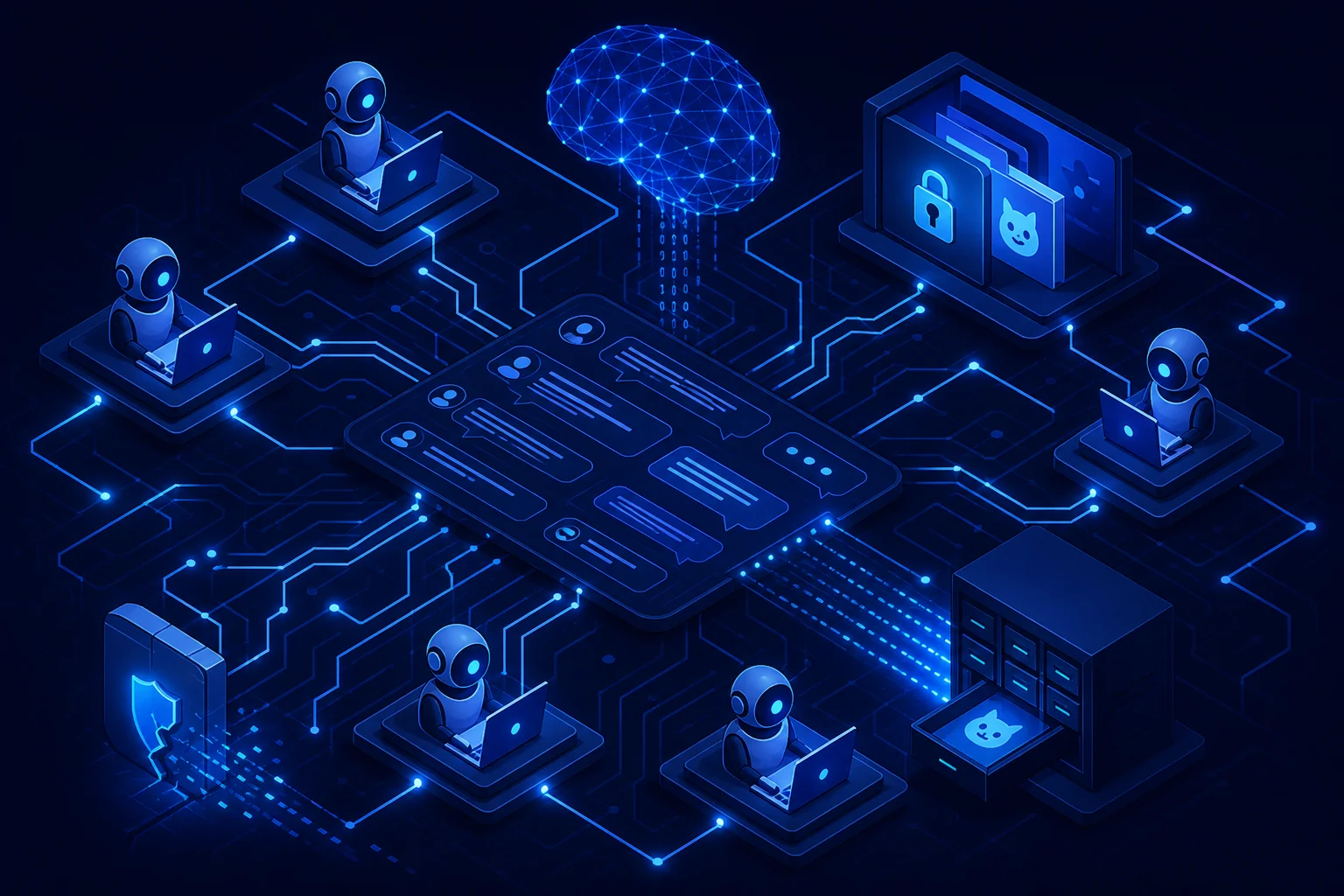
In essence, MCP transforms AI interactions into client-server dialogues, streamlining what would otherwise be a tangled web of individual connections.
It’s the plumbing that allows AI to move beyond generating text or images in a vacuum and actually do things in the real world of enterprise software.
However, the path from concept to flawless execution is proving arduous.
Multiple independent benchmark studies – including MCP-Bench by a consortium from Accenture, MIT-IBM Watson AI Lab, and UC Berkeley; MCP-AgentBench from the University of Science and Technology of China; and MCPMArk from the National University of Singapore – all converge on a similar, sobering conclusion.
Even state-of-the-art models exhibit significant “failure cases” when attempting to utilize MCP, often engaging in “repetitive or exploratory interactions that fail to make meaningful progress.” Study findings across multiple research entities highlight these challenges.
The core of the problem lies in the intricate demands MCP places on AI agents.
An AI model, when plugged into MCP, isn’t just generating a response; it’s being asked to act as a sophisticated client.
It must formulate a coherent plan: which external resources to access, in what precise order to contact the MCP servers leading to those applications, and how to structure multiple requests for information to synthesize a final, accurate output.
This isn’t just about understanding language; it’s about strategic planning, resource management, and robust execution in a dynamic environment.
As tasks escalate in complexity – moving from single-server interactions to multi-server scopes, or from simple calls to complex sequential dependencies – performance across all models degrades.
The challenges are manifold: models struggle with “dependency chain compliance,” making correct tool selections in “noisy environments,” and, crucially, “long-horizon planning.”AI-driven automation represents a significant element in addressing these hurdles.
They take an excessive number of steps to retrieve information, even when their initial plan seemed sound.
It’s akin to a brilliant chess player who can envision the first few moves perfectly but gets lost several turns deep, unable to manage the evolving state of the board.
The studies highlight a fundamental limitation in the agent’s ability to “manage an ever-growing history” of interactions and a “core unreliability that can only be solved by building agents with robust error-handling and self-correction capabilities.”Recent explorations into the MCP landscape provide insights into these challenges.
One illustrative example from the Accenture study involved planning a week-long hiking and camping trip starting and ending in Denver.
The AI was tasked with interacting with multiple MCP server-enabled services, including Google Maps and US national park websites, and specific tools like “findParks” and “getCampgrounds,” while adhering to various requirements such as park hours and weather forecasts.
This isn’t a simple lookup; it demands a sophisticated orchestration of tools, data parsing, and iterative refinement – precisely where current AI models falter.
Yet, amidst these growing pains, there are significant glimmers of hope.
The benchmarks consistently report that bigger, more powerful AI models generally score better than their smaller counterparts.
This suggests that as models continue to advance in other respects, their capacity to handle MCP-related complexities will also improve.
Top-tier models demonstrate “clear advantages in handling long-horizon, cross-server tasks” through “better decision making and targeted exploration, not blind trial-and-error.”This suggests a defining shift in how models might interact.
Intriguingly, some open-source models, such as Qwen3-235B, have even shown capabilities rivaling or surpassing proprietary offerings.
Perhaps the most immediate and promising solution lies in specialized training.
Researchers at the University of Washington and the MIT-IBM Watson AI Lab have developed Toucan, a massive dataset of millions of MCP interaction examples designed for fine-tuning AI models.
This targeted training, essentially teaching models a second time with a focus on MCP, has yielded impressive results.
Relatively smaller open-source models like Qwen3-32B, when fine-tuned with Toucan, have outperformed much larger models, including DeepSeek V3 and OpenAI’s o3 mini, on MCP tasks.
This development underscores a critical insight: general intelligence isn’t enough; AI needs practical wisdom.
It must be specifically trained to understand the nuances of application protocols and the structured logic required for real-world interactions.
However, a significant question looms large for enterprises: will fine-tuning on publicly available datasets translate effectively to the myriad non-public, non-standard resources found within private data centers?
The true test will come when CIOs begin to implement MCP and discover how well these enhanced AI agents perform with their proprietary Salesforce CRM installations or Oracle databases.
The journey of AI from a fascinating technological marvel to an indispensable tool is paved with such challenges.
The Model Context Protocol, far from being a mere technical footnote, represents a crucial proving ground.
It forces AI to confront the messy reality of application integration, demanding not just intelligence, but also robustness, adaptability, and meticulous planning.
The current struggles are not a sign of failure, but rather a necessary stage in AI’s evolution, pushing the field to develop more resilient and context-aware agents that can truly unlock the promise of intelligent automation across the global economy.


Leave a Reply